
Free written scope consultation - allowances, timeline, and change-order rules on paper before a single trade is scheduled
 Before
 After
After Before
 After
After Before
 After
AfterQuikrete Kitchen Remodeling: The Los Angeles Owner’s Guide
If you’re searching for Quikrete kitchen remodeling in Los Angeles, you’re likely staring at a failed countertop, a cracked tile bed, or a floor that’s started to move underfoot. Penhallow Remodeling stocks and installs Quikrete-compatible surfacing materials and substrates for kitchens throughout Los Angeles, with full kitchen remodels typically running $16,520 to $53,100 depending on layout, cabinet line, and countertop material. We’re an independent remodeling contractor, not affiliated with Quikrete, but we work with their products regularly because they hold up well in LA’s dry heat and occasional seismic shifting.
Most homeowners discover a Quikrete-related failure the same way: a hairline crack starts at a corner, a tile pops loose near the sink, or the grout keeps crumbling no matter how many times you re-seal it. What’s underneath matters more than what’s on top. That’s where we start every Los Angeles kitchen we touch.
Which Quikrete Models This Applies To
Quikrete isn’t a single product line, it’s a materials system. In kitchen remodeling, the parts that fail are almost always one of three things: the mortar bed under floor tile, the concrete backer board behind a backsplash, or the self-leveling underlayment poured over an old slab before new flooring goes down. Each has a spec range, and matching the right one to your kitchen matters more than most homeowners realize.
The most common compatibility gotcha we see in Los Angeles: Quikrete Floor Mud (their deck mud) is not the same thing as their Sand Topping Mix, and using one where the other belongs shortens the life of the tile bed by years. Floor Mud is designed for thick-bed installations at 3/4 inch to 2 inches, while Sand Topping Mix handles thinner repairs. If your old floor was set in a thick mortar bed, and a previous contractor patched it with a thin-set product, that’s why you’re seeing cracks now. For backer board, Quikrete’s 1/2-inch cement board is the standard behind kitchen backsplash tile, but it must be installed over a properly prepared substrate (the moisture-resistant layer behind your tile), not directly over drywall that’s already softening.
On the countertop side, Quikrete’s Countertop Mix is a legitimate budget alternative to slab stone, but it demands a perfectly level form and a proper sealant schedule. In Los Angeles kitchens, where hard water and citrus spills are daily realities, an unsealed Quikrete countertop will stain and etch within six months. We stock Quikrete-compatible materials on our trucks for most standard repairs, and we source OEM-spec equivalents when a job calls for it. The aftermarket versions of their mortar and backer products are generally fine if they meet the same compressive strength ratings, but for countertop work, we stick with the real thing.
Signs Your Quikrete Kitchen Remodeling Is Failing
- Tile cracking along a straight line, not a spiderweb. That usually means the substrate underneath is moving, not the tile itself. In Los Angeles, this often traces back to a mortar bed that wasn’t packed correctly or a concrete slab that’s shifted. The tile is just reporting the problem.
- Grout that keeps crumbling in the same spots. Re-grouting without fixing the movement underneath is a temporary patch. If the bed is flexing, new grout will fail again in weeks, not years.
- Hollow-sounding tile when you tap it. That hollow sound means the tile has debonded from the mortar. It can stay in place for months, then crack suddenly when you drop a pot or a jar. By the time you hear the hollow, the repair window is closing.
- Water staining or soft drywall below the backsplash. Once moisture gets behind the tile, the cement board loses its grip and the wall structure starts degrading. In older Los Angeles homes with wood framing, this spreads faster than most people expect.
- Countertop surface feels gritty or chalky to the touch. That’s the sealant failing and the cement matrix starting to erode. Once the surface is porous, every spill works its way in, and cleaning becomes a losing game.
Replacement Cost & What’s Included
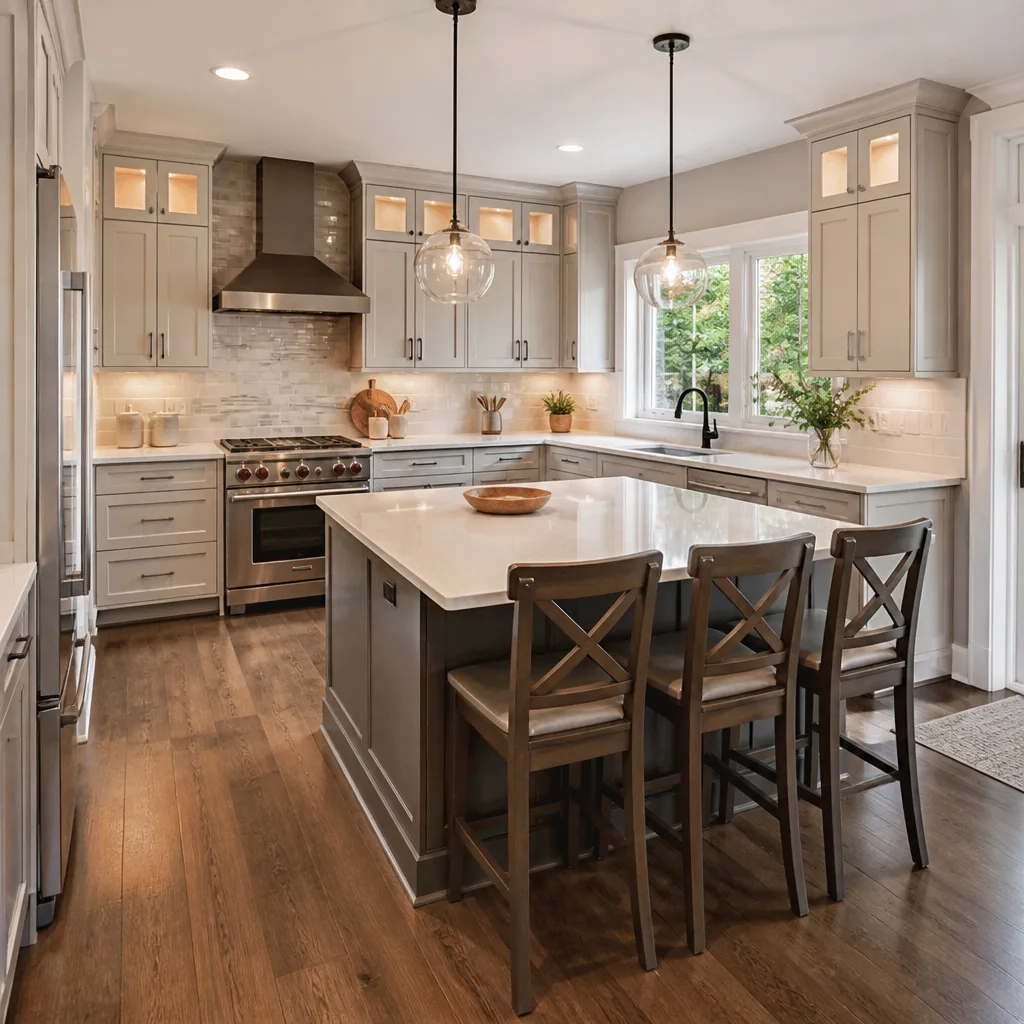
Kitchen remodeling with Quikrete-compatible materials in Los Angeles runs $16,520 to $53,100 for a full project. That range covers everything from a modest galley kitchen refresh with stock cabinets and a Quikrete countertop to a larger open-plan remodel with custom cabinetry, new flooring, and full tile work. Smaller scoped repairs, like re-setting a failed tile bed or replacing a backsplash substrate, start lower, but a full kitchen overhaul is the realistic frame for this price band.
| Project Scope | Typical Los Angeles Price Range |
|---|---|
| Full Kitchen Remodel | $16,520 – $53,100 |
| Small Kitchen Remodel | $10,620 – $23,600 |
| Backsplash Installation | $945 – $2,950 |
| Countertop Installation | $2,360 – $7,670 |
| Cabinet Installation | $4,720 – $15,340 |
What drives the number up: layout changes that move plumbing or electrical, custom or semi-custom cabinet lines, slab countertops versus Quikrete or laminate, and the condition of what’s underneath once we open things up. What drives it down: keeping the existing footprint, using stock cabinetry, and catching substrate problems before they spread. Every Penhallow Remodeling project starts with a written price, in hand, before any work begins. That number is the number on the final invoice, backed by our 365-Day Done Right Promise. If something fails inside that year, we come back and fix it at no charge, in writing, on every job.
DIY or Call Us?
There are things a homeowner can safely check: cracking patterns, hollow-sounding tiles, the condition of grout, and whether the countertop surface feels chalky. None of that requires tools, and it helps you talk to a contractor from a position of knowing what you’re dealing with.
What we don’t recommend is pulling up tile or cutting into a backsplash yourself. The mortar bed underneath is where the real diagnosis happens, and once you start removing material, you’re committing to a repair whether the problem is bigger or smaller than you thought. Dust control in a Los Angeles kitchen matters too: cement board and old mortar create silica dust that requires proper containment, not a tarp and an open window. If the tile bed has failed, the repair involves removing the old mortar, checking the subfloor, and re-setting the bed to spec, which is a full trade skill, not a weekend project. Give me the whole picture first, then we pick up the tools. Call (936) 259-2607 and we’ll walk through what you’re seeing before anyone schedules anything.
FAQs
A properly installed Quikrete mortar bed and cement board substrate should last 20 to 30 years in a Los Angeles kitchen, but the visible surfaces above them, tile, grout, and sealant, typically need attention every 10 to 15 years depending on use and water exposure. If the substrate was done wrong, failures show up much sooner, sometimes within the first year, which is exactly what our 365-Day Done Right Promise is designed to catch. Call (936) 259-2607 if you’re seeing early signs and we’ll take a look.
In most cases, a failed mortar bed cannot be reliably patched, because the problem is usually structural: the bed has debonded from the floor or cracked through. Small isolated spots can sometimes be re-set, but if you’re seeing multiple cracks or hollow areas, the right fix is removal and a new bed. We’ll tell you which situation you have after a site visit, and you’ll have a written price before any work starts.
A full kitchen remodel in Los Angeles typically takes 4 to 8 weeks from the first day of demo to final walkthrough, depending on cabinet lead times and whether the layout changes. A substrate or backsplash repair is usually a 2 to 3 day job. We’ll give you a real arrival window and a written schedule with your written quote, and we hold ourselves to both.
We keep Quikrete-compatible mortar, backer board, and countertop materials stocked on our trucks for standard repairs, and we can source OEM-spec Quikrete products through our Los Angeles suppliers for larger remodels. We also work with complementary trade brands like KraftMaid cabinetry, Cambria and Silestone countertops, and Kohler and Moen fixtures, so the products behind our guarantee are as solid as the promise itself. Call (936) 259-2607 for a free estimate on your Quikrete kitchen remodeling in Los Angeles.
Written by Trevor Nash, Owner, Penhallow Remodeling at Penhallow Remodeling, serving Los Angeles and nearby areas.