
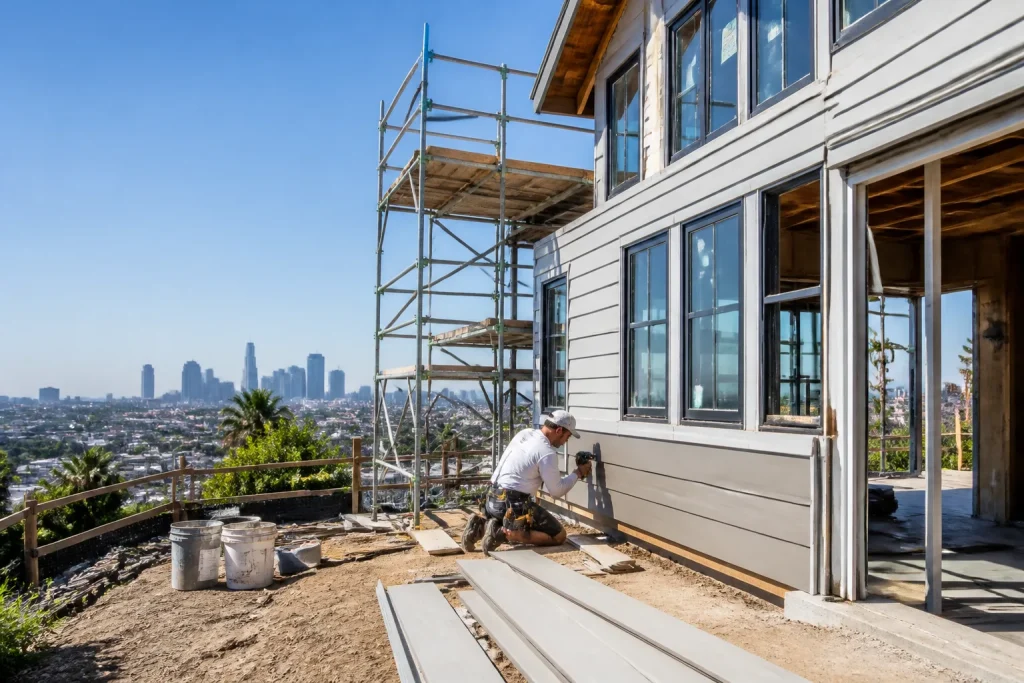
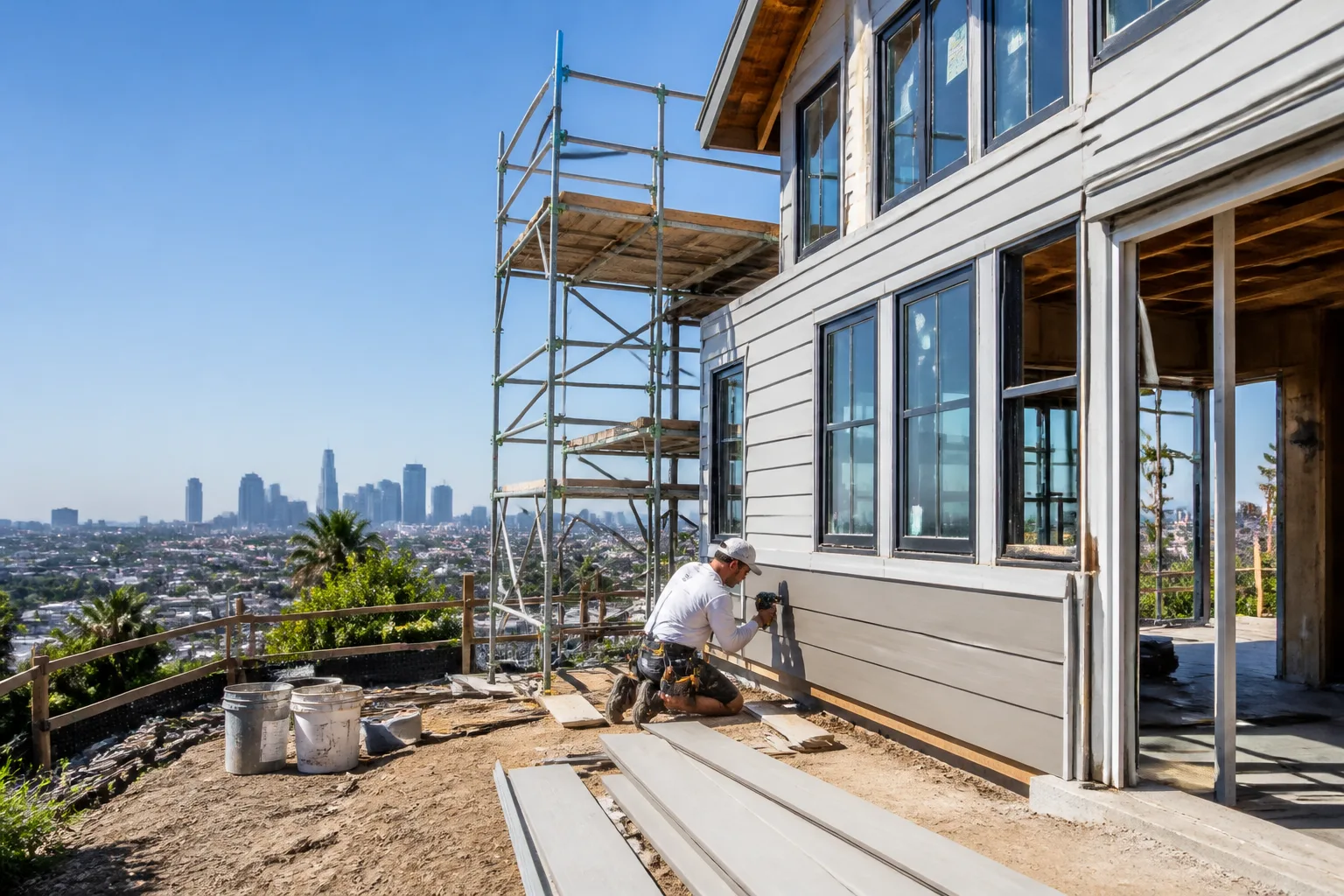
James Hardie General Contractor in Los Angeles: A Homeowner’s Guide
James Hardie siding earns its reputation in Los Angeles not because it looks good, though it does. Fiber cement is one of the few exterior cladding materials that satisfies LA fire code in the Very High Fire Hazard Severity Zones, passes HOA review without a fight, and keeps its paint color through years of brutal UV exposure. But all of that falls apart if the installation skips Hardie’s published technical bulletins. This guide explains what Los Angeles homeowners need to know before signing a contract, and why the installer matters more than the product.
James Hardie Will Void Your Warranty for a Two-Inch Gap
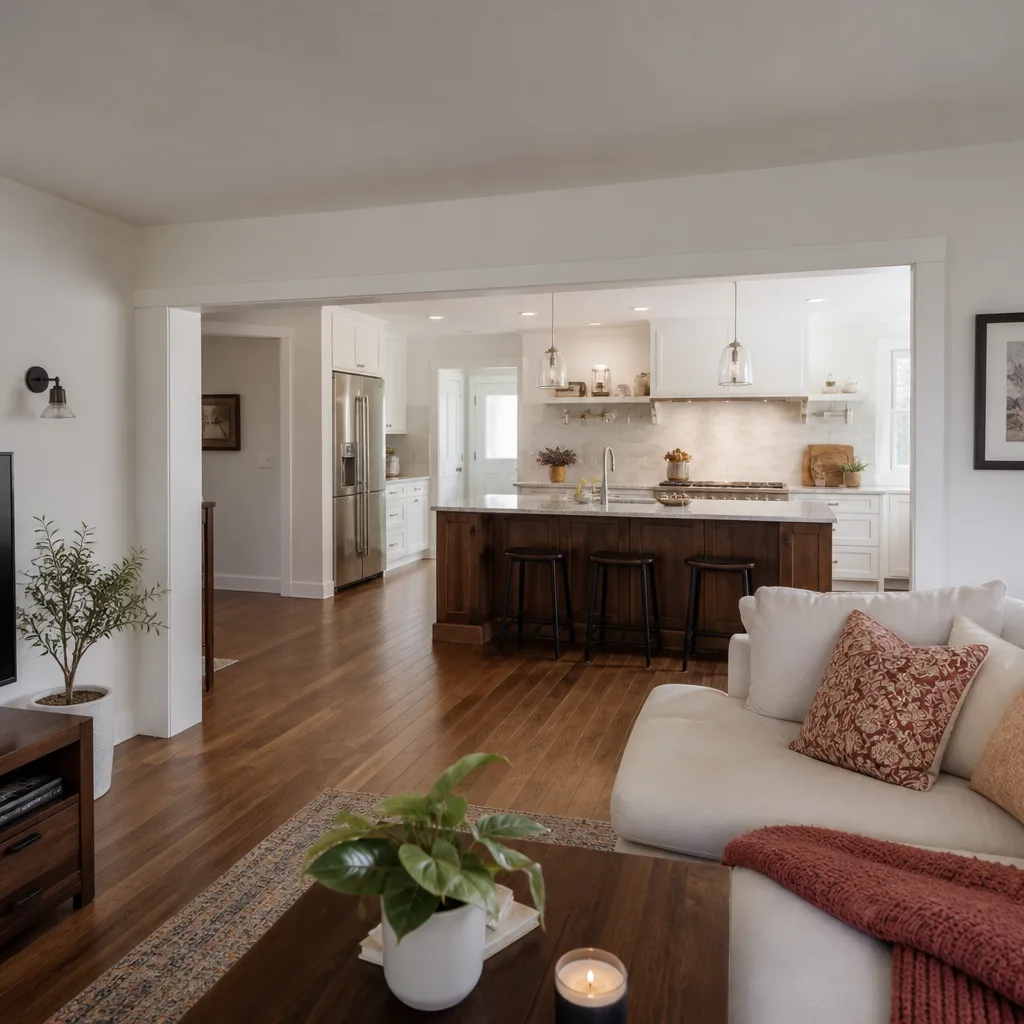
Here’s the detail almost nobody tells you: Hardie requires a minimum 2-inch clearance between the bottom edge of the first siding course and finished grade. That gap lets water splash off the ground without wicking into the fiber cement. Get it wrong, and Hardie’s product warranty is void before the painters show up. We’ve walked past new construction in Echo Park and Silver Lake where the bottom course practically kisses the dirt. No amount of caulk fixes it after the fact. The board has to be pulled and rehung. This is the kind of thing a general contractor who reads the technical bulletin catches on day one, and a crew that’s only ever hung wood siding blows right past.
Fiber cement looks forgiving. It’s not. Hardie publishes technical bulletins for ground clearance, fastener type, butt joint treatment, flashing sequence, and wall-ventilation requirements. Each one exists because a real failure happened somewhere. In Los Angeles, where we get maybe 14 inches of rain a year but all of it comes in four or five hard storms, flashing mistakes don’t show for a season or two. Then the wall rots from the inside while the siding looks fine from the street.
What ‘HardiePlank Preferred Contractor’ Actually Means
Hardie sells products through thousands of lumberyards in Southern California. Any licensed contractor with a credit line can order HardiePlank lap siding, HardiePanel, and HardieTrim. That’s not the same as knowing how to install it. The HardiePlank Preferred Contractor designation is a training and certification program through James Hardie. It requires installers to complete product-specific coursework, agree to follow the technical bulletins, and carry installation best-practices from Hardie’s own trainers. It’s not a lifetime stamp either. Contractors renew and retrain.
Why does that matter to a homeowner in Los Angeles? Because the warranty follows the installation. Hardie’s product warranty covers manufacturing defects. What it does not cover is a bad install. When a contractor skips the required moisture barrier or flashes the window wrong, that failure is between you and the contractor, not you and James Hardie. A general contractor like Penhallow Remodeling, who installs Hardie products to spec and documents the process, gives you two layers of protection: the manufacturer’s product warranty and our written workmanship guarantee. A crew that just knows how to swing a nail gun gives you neither.
Here’s what Hardie’s technical bulletins require on a Los Angeles exterior:
- Water-resistive barrier (WRB): A code-approved weather barrier like Tyvek or a fluid-applied membrane goes on the sheathing before the first board. Hardie products are not waterproof. The WRB is the actual rain defense. Siding is the armor on top.
- Flashing at every penetration: Windows, doors, hose bibs, light fixtures, meter boxes. Each one gets tape or metal flashing that directs water out and down. Skipping this is how you get black mold behind the wall.
- Bottom edge clearance: 2 inches above grade, 1 inch above hardscape like a patio or walkway. No exceptions. Not in Woodland Hills, not in Atwater Village.
- Proper fasteners: Corrosion-resistant, driven into studs, not just sheathing. Siding that’s only nailed into OSB starts to sag and ripple within a few LA summers.
- Butt joint treatment: Joints get flashed or caulked per Hardie’s spec. The boards move with temperature swings. In Los Angeles, a south-facing wall can hit 140 degrees on the surface in August and drop 70 degrees that night. That movement pulls apart sloppy joints.
LA Fire Zones Are the Real Reason Fiber Cement Wins
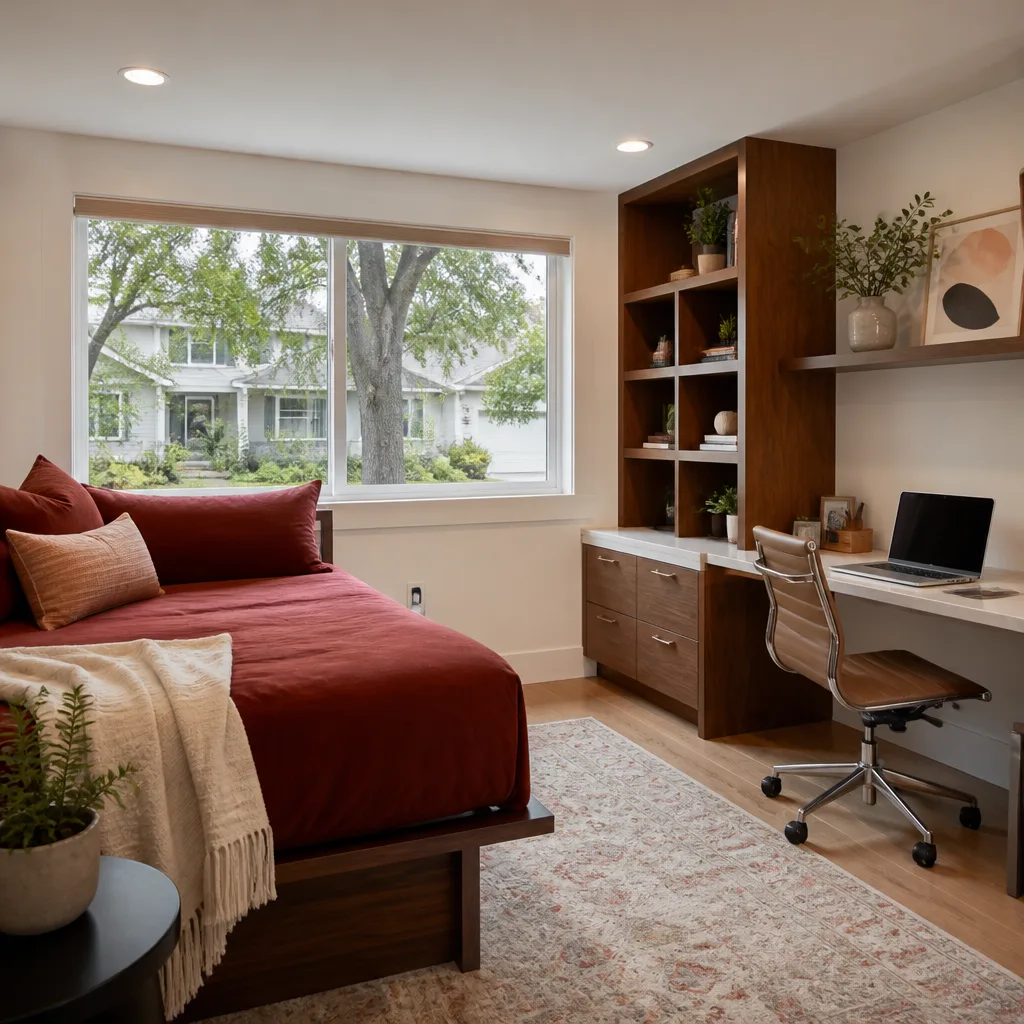
Los Angeles County maintains maps of Very High Fire Hazard Severity Zones. A huge share of the hillside neighborhoods are in them: large parts of Sherman Oaks south of Ventura Boulevard, Bel Air, Brentwood’s canyon streets, Studio City near Fryman Canyon, most of the Santa Monica Mountains communities, the foothill areas in La Cañada Flintridge, Tujunga, and Sunland. If you live in one of these zones and you’re doing a re-roof, an addition, or any permitted exterior work, the building department will look at what’s on your walls.
California Building Code Chapter 7A requires exterior wall cladding in wildfire zones to meet ignition-resistance standards. Fiber cement passes. Wood siding generally doesn’t, not without expensive treatments and special sheathing. Stucco passes too, but stucco has its own issues, which we’ll get to in a minute. Vinyl siding is effectively a non-starter in Chapter 7A territory. It burns, it melts, and it carries a bad reputation with fire marshals. If you’re adding to a canyon house in the 90210 or 91423 ZIP codes, fiber cement isn’t a style choice. It’s the material that gets you through plan check without a fight.
That’s not paranoia. When a house in a Very High Fire Hazard Severity Zone changes hands, insurance carriers are now asking what’s on the exterior. Fiber cement, with its Class 1(A) fire rating, is one of the answers that gets you a policy at a rate that doesn’t feel like extortion. We’ve had homeowners in Tarzana and Encino tell us their agent actually lowered their premium after they swapped old wood siding for Hardie. We can’t promise that for every house, but the trend is real.
The Water Barrier and Flashing Sequence Nobody Sees
The part of the siding job that matters most is the part you’ll never look at. That’s the sequence behind the boards. Hardie’s technical bulletin HZ10, the installation guide, spells out the order of operations. In the right hands, a Hardie exterior in Los Angeles gets built from the inside out:
- Sheathing inspection: You can’t fasten siding to rotted particle board. If there’s damage, it gets cut out and replaced before any barrier goes up.
- Water-resistive barrier: House wrap or fluid-applied membrane, lapped shingle-style so water flows down and out, never trapped behind a seam. Taped at all penetrations.
- Flashing at horizontal transitions: Where two wall sections meet, where the wall rests on the foundation, anywhere water can sit. Metal flashing or tape goes under the WRB, not just on the surface.
- Window and door flashing: Sill pan flashing first, then side jambs, then head flashing that laps over the side tape. Water that gets behind the siding gets directed back out.
- Then and only then, the Hardie product. Cut outside or in a dust-controlled shop, never dry-cut indoors near the house. The silica dust from fiber cement is serious: Hardie requires cutting with dust-reduction methods, and California OSHA enforces silica rules aggressively.
When a contractor skips step 4 in Los Angeles, you don’t see it for years. Then a window leaks during a February atmospheric river, the drywall underneath gets soft, and the fix costs ten times what the flashing tape would have cost. This is where the cheap bid gets expensive. The contractor who charges $4,000 less probably isn’t saving you money. He’s saving himself time on steps you’ll never inspect.
If you want our honest take from walking Los Angeles job sites: ask any contractor bidding your Hardie job to walk you through their flashing sequence in writing. If they can’t explain it in plain English, that’s your answer. If they won’t put it in the contract, that’s also your answer.
The Paint Warranty Fine Print Most Installers Skip
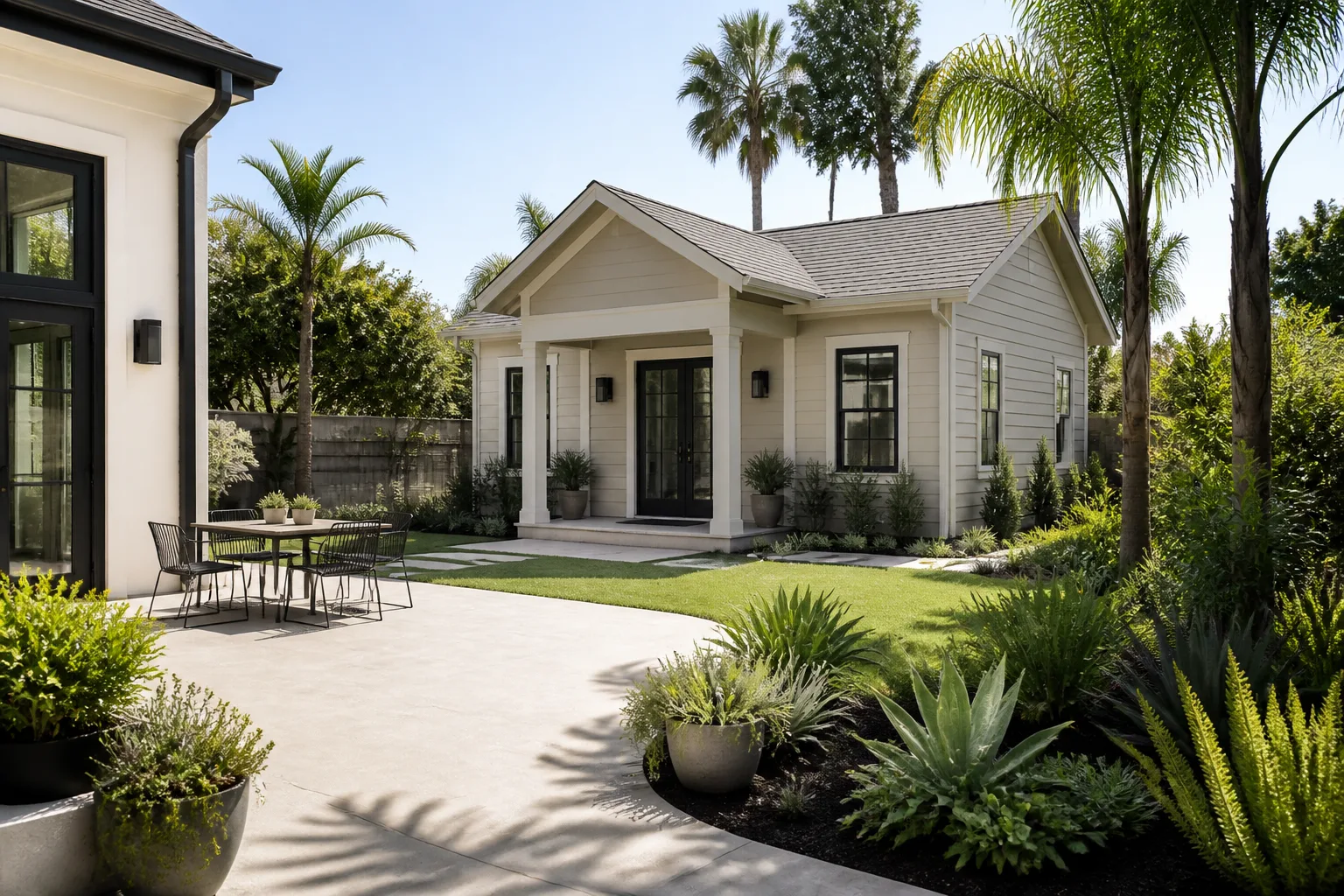
James Hardie offers two ways to finish siding: ColorPlus Technology, the factory-applied paint that comes on the board from the mill, or site painting after installation. Homeowners love ColorPlus because it’s a baked-on, multi-coat finish that carries a 15-year fade and peel warranty. Here’s the detail that matters in Los Angeles, where the sun will try to bleach every painted surface you own.
The ColorPlus warranty only stays in force if site-painted touchups, cut-edge sealing, and any field-applied finish use approved Sherwin-Williams colorants and products from Hardie’s own color-matching system. Let a painter hit the snapped chalk line with the wrong off-the-shelf paint, and Hardie can wash its hands of the whole finish warranty. We see it happen all over LA: a perfectly good ColorPlus install gets touched up with whatever semi-gloss was on sale at the corner paint store, and the homeowner doesn’t learn the difference until a warranty claim gets denied three years later.
The cut edges matter too. Every factory-painted Hardie board gets cut on the job site, and every cut edge exposes raw fiber cement. Hardie requires those edges to be sealed with an approved primer at installation. Skip it, and moisture wicks into the board at every cut seam, slowly blistering the paint from behind. In Los Angeles, where irrigation overspray hits the first course of siding on most houses, that edge sealing isn’t optional. It’s the difference between a wall that looks good for twenty years and one that starts flaking at the bottom course in season three.
What Hardie Siding Costs in the Los Angeles Market
Here’s where we’ll give you real numbers instead of a shrug. In Los Angeles, exterior siding work runs on a different scale than, say, Arizona or Texas. Labor is higher, permits are a factor, and hillside access adds equipment costs.
For a typical single-story Los Angeles house with roughly 1,800 to 2,500 square feet of wall area, installed HardiePlank lap siding, including demolition of the old cladding, WRB, flashing, and paint, typically runs $18,000 to $42,000 depending on height, access, existing wall condition, and finish choice. Broken down per square foot of wall area, that’s about $10 to $17 per square foot installed. ColorPlus boards add about 8 to 12 percent over primed boards that get site-painted, but the 15-year finish warranty usually makes up the difference on a Los Angeles wall that takes sun all day.
How does that compare to the alternatives?
- Vinyl siding: $6 to $10 per square foot installed. Cheaper on paper, but a poor fit for Los Angeles fire zones, and it warps in high heat, leaving gaps and rattles. Most HOAs in older LA neighborhoods reject it outright.
- Stucco re-coat: $8 to $12 per square foot. If your house has intact stucco and it just needs a new color coat or a base-coat repair, this is the budget move. But stucco hides rot until it’s advanced, and full re-stucco is no cheaper than Hardie once you’re down to the studs.
- HardiePanel vertical siding: $11 to $16 per square foot installed. Modern look, fewer seams, works well for mid-century remodels in the hills above Studio City, but the material cost is higher per square foot of wall.
The real cost driver in Los Angeles isn’t the board, it’s the labor and the access. A two-story house on a hillside in Mount Washington costs more than a one-story ranch in Torrance. A wall that requires scaffolding and debris removal by hand costs more than a driveway with easy forklift access. Anyone who quotes you a Hardie job without asking about slope, access, and the existing wall condition is guessing, not bidding.
When to Call a Pro, Not a Siding-only Sub
There’s a difference between a siding subcontractor and a general contractor who manages the whole exterior. If your Hardie job is simple, like re-cladding a freestanding garage with straight walls and easy access, a competent siding-only crew can handle it. But the moment the job touches a window, a door, or a roofline, you’re into general contractor territory. Here’s the trigger list we use with Los Angeles homeowners:
- The old siding removal exposes sheathing damage, termite runs, or dry rot. Somebody has to make the call on what gets replaced and what stays.
- Windows are getting replaced as part of the same project. Flashing from the window to the WRB is the detail that fails most often when two different crews work the same wall.
- The house is two stories or on a slope. Scaffolding, debris management, and site safety become the hardest part of the job.
- The property is in a fire severity zone and the permit package needs a Chapter 7A compliance statement.
- The HOA requires material samples, a color palette approval, and a licensed contractor signature before work starts.
In those cases, a General Contractor in Los Angeles who manages the whole project beats a siding sub because one company owns the flashing, the barrier, the window interfaces, and the final inspection. If a seam leaks, there’s no argument between the window guy and the siding guy about whose fault it is. It’s our job, our call, our guarantee.
For related interior and exterior updates, we work with homeowners on Kitchen Remodeling in Los Angeles and Bathroom Remodeling in Los Angeles as part of the same project. When the exterior goes under the knife, it’s usually the same season the homeowner finally pulls the trigger on that dated kitchen or the bathroom that’s been leaking behind the tile since the Obama administration. Better to coordinate it all once than to live through two demolition projects.
The Bottom Line
James Hardie siding is a smart choice for Los Angeles houses in fire zones, on sunny south-facing lots, and in HOAs that want a clean, uniform exterior. But the product is only as good as the installation behind it. A two-inch ground clearance, a properly sequenced water barrier, sealed cut edges, and the right Sherwin-Williams touchup products are the difference between a wall that lasts 30 years and a warranty that dies in year two. The cheap bid in Los Angeles almost always skips one of those steps.
If you’re weighing a siding project in Los Angeles, we’d be glad to walk your property and write you a real price, not a ballpark range. That written number comes before any work starts, and our Done Right Promise covers every repair in writing for a full year. If something we built fails, we come back and fix it. No service call fee, no re-inspection charge. If you’d rather not sort through the technical bulletins yourself, call (936) 259-2607 for a free estimate.
Frequently Asked Questions
Most exterior re-siding work in Los Angeles requires a building permit, especially if you’re replacing sheathing, changing wall surfaces in a fire hazard zone, or altering window openings. The short answer: yes, expect a permit, and make sure your contractor pulls it. A legit Los Angeles general contractor will handle the permit package, the Chapter 7A compliance statement if you’re in a Very High Fire Hazard Severity Zone, and the inspection. Anyone who tells you to skip the permit is selling you a problem. Call (936) 259-2607 and we’ll tell you what applies to your specific property.
A typical single-story house with 2,000 square feet of wall area takes 2 to 3 weeks from first board removal to final paint touchup, assuming no major dry rot surprises. Two-story or hillside houses in neighborhoods like Echo Park or Mount Washington can run 3 to 5 weeks because scaffolding and debris removal are slower. The weather in Los Angeles rarely delays siding work, but the permitting office and inspection schedule can add a week or two. Call (936) 259-2607 for a timeline specific to your project.
Not if the original scope is accurate. Penhallow puts the entire job, including framing repairs we can see, the barrier, flashing, siding, trim, and waste removal, in writing before we put a tool to the wall. The only thing that changes a written price is a surprise inside the wall: hidden termites, rotted sheathing that wasn’t visible before demo, or code upgrades the inspector requires. When those come up, we tell you the cost before we do the work, in writing. If you want that kind of certainty on your Hardie job, call (936) 259-2607.
In our experience, yes, especially in fire hazard zones and in neighborhoods where the old wood siding has hit the end of its life. Buyers in Los Angeles took notice after the 2025 fire season, and fiber cement is one of the few exterior materials that insurance underwriters and building inspectors both approve without hesitation. The paint warranty matters too: a 15-year fade warranty in LA’s sun is a selling point, not a footnote. But no siding adds value if it’s installed wrong, so the installer’s guarantee matters as much as the product’s. Call (936) 259-2607 and we’ll walk your house with you.
Written by the team at Penhallow Remodeling.
Need Construction Help?
Call Penhallow Remodeling - licensed & insured, here with fast after-hours help in Los Angeles.
(936) 259-2607