
Free written scope consultation - allowances, timeline, and change-order rules on paper before a single trade is scheduled
 Before
 After
After Before
 After
After Before
 After
AfterCambria Roofing: The Los Angeles Owner’s Guide
Cambria roofing repair in Los Angeles typically runs $470 – $2,125 for most failures, and full replacements land between $9,440 and $23,600 depending on roof size, pitch, and material condition. We stock Cambria-compatible roofing materials in our Los Angeles service vehicles and can usually diagnose and quote the job the same day we look at it. Most homeowners discover a Cambria roofing problem the same way: a water stain on the ceiling after a heavy rain, a shingle in the yard after a Santa Ana wind event, or granules collecting in the gutter after a hot summer stretch.
Penhallow Remodeling is an independent Los Angeles contractor. We’re not affiliated with Cambria, but we work with Cambria roofing products regularly and know which replacement parts match which roof systems without guesswork.
Which Cambria Models This Applies To
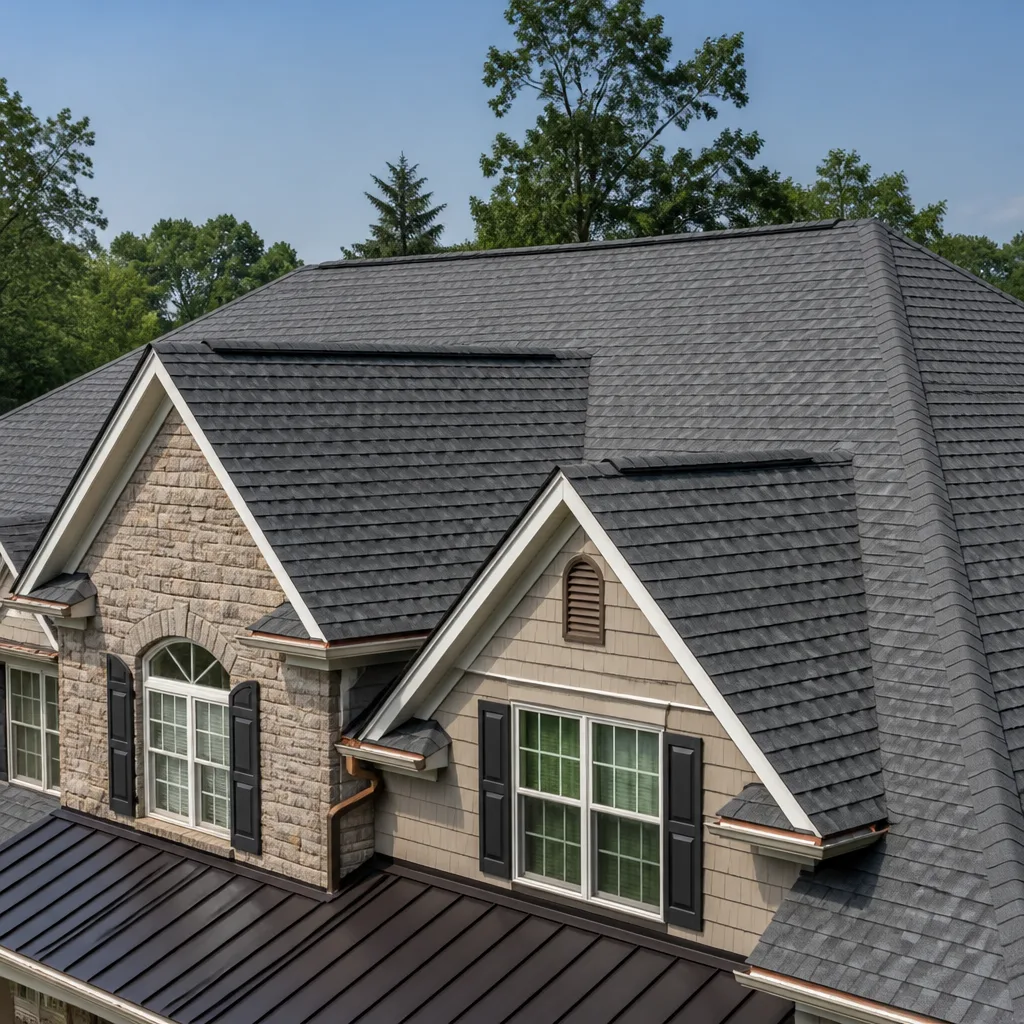
Cambria’s roofing line splits into two main families: the Cambria Architectural Series (asphalt shingles with a dimensional profile, rated for 110+ mph wind uplift) and the Cambria Stone-Coated Steel Series (galvanized steel panels with a stone granule finish, typically 26-gauge). The parts you need depend entirely on which family sits on your Los Angeles roof.
Architectural Series failures are almost always isolated: a cracked shingle, a loosened ridge cap, a deteriorated pipe boot. Stone-Coated Steel failures are rarer but more specific: a panel fastener backing out, flashing separation at a valley, or stone granule loss exposing the steel substrate to coastal moisture. Here’s the compatibility gotcha: Cambria’s stone-coated steel panels from pre-2018 runs use a different fastener profile than current production. If your roof was installed before 2018, you cannot simply order current-gen fasteners and expect a tight seal. We match fasteners by measuring the existing head diameter and thread pitch, not by the panel model alone.
For the OEM vs. aftermarket decision: Cambria-branded replacement parts cost 20 – 40% more than quality aftermarket equivalents, and for most Architectural Series repairs, an aftermarket shingle matched by dimension and color code performs identically. For Stone-Coated Steel, we recommend OEM panels when the roof is under the manufacturer’s transferable warranty; aftermarket steel panels rarely match the stone color profile closely enough for a clean visual match on a prominent slope.
Signs Your Cambria Roofing Is Failing
- Granules in the gutter or downspout. On Architectural Series roofs, this means the asphalt surface is breaking down from UV exposure. Los Angeles roofs get hammered by sun; by year 12 – 15, significant granule loss is common even on well-installed roofs. On Stone-Coated Steel, granule loss exposes the steel layer, which then starts oxidizing within one rainy season.
- Water staining on ceilings or exterior walls. This is almost never a single-point failure. Water travels laterally along the roof deck before it drops, so the stain rarely lines up with the actual breach. We trace the path from the stain back to the penetration point, which is usually a flashing issue, not the roofing material itself.
- Shingles lifting after wind events. Santa Ana winds in Los Angeles regularly gust 50 – 70 mph. If you see shingle corners lifting or hear flapping, the adhesive seal strip has failed. Cambria Architectural shingles have a wind-rated seal that should hold to 110 mph, but once the seal loses its bond, the shingle becomes a sail.
- Rust streaks on Stone-Coated Steel panels. This is a panel-level issue, not surface staining. If you can see rust lines running vertically from a fastener or a cut edge, water is sitting against exposed steel. Left alone through one Los Angeles winter, that panel becomes a leak source.
- Missing ridge caps or exposed fasteners. The ridge is the roof’s most vulnerable line. Ridge caps take the brunt of wind shear, and fastener seals degrade fastest there. Any exposed fastener head is an entry point for water, even if it looks tight from the ground.
Replacement Cost & What’s Included
For Los Angeles Cambria roof repairs, you should expect installed pricing between $470 and $2,125. Small fixes sit at the low end: a single pipe boot replacement, a dozen shingle replacements, a resealed valley. Bigger repairs climb toward the top of that range: flashing replacement around a dormer, a full ridge cap re-run, or a 100-square-foot section rebuild.
Here’s the breakdown of what drives the number:
- Material match cost: OEM Cambria parts run higher than aftermarket equivalents. We quote both options when both make sense.
- Access: A single-story ranch roof in the San Fernando Valley is a fast job. A two-story roof with limited ladder access in the Hollywood Hills takes longer and costs more in labor.
- Scope of substrate repair: If the roof deck itself is water-damaged under the failed area, that plywood or OSB replacement adds to the total.
- Permit requirements: Most repair work in Los Angeles doesn’t require a permit, but if the repair crosses into structural territory, we pull the permit and pass the cost through at cost.
Every repair gets a written price before we touch the roof, a written 365-Day Done Right Promise on the work, and a free return visit if anything we fixed fails inside that window. We don’t do verbal ballparks.
DIY or Call Us?
You can safely do the visual check: look for lifted shingles, missing granules, rust streaks, or debris dams from the ground or a ladder. What you should not do is walk a Los Angeles roof without proper tie-off, and you should not attempt to reseat a stone-coated steel panel or replace flashing yourself. Roof work at height is genuinely dangerous, and the repair itself requires matching sealants, correct fastener torque, and knowing how to strip and re-bed flashing without creating a bigger leak than you’re fixing.
When a homeowner tries to patch a roof leak from above without understanding how water moves under the surface, we usually get called weeks later to fix both the original issue and the new one. Trevor Nash has spent years in Los Angeles construction, and his take is the same every time: “Give me the whole picture first, then we pick up the tools.” That’s the standard we hold every repair to.
Call (936) 259-2607 and we’ll walk you through what we need to know, schedule the visit, and give you a written number before any work begins.
FAQs
Cambria Architectural Series shingles typically last 20 – 25 years in Los Angeles conditions, though inland heat zones like the Valley can shorten that to 15 – 20 years. Stone-Coated Steel panels are rated for 40 – 50 years, but fastener and flashing failures at the 15-year mark are the more common reason for repair. Call (936) 259-2607 if you want us to assess where your roof sits on that timeline.
Yes, in most cases. Isolated shingle damage, flashing separation, and ridge cap failure are routine repairs that don’t require touching the rest of the roof. Full replacement only becomes necessary when granule loss covers more than about 30% of the roof surface, or when the deck underneath shows widespread water damage. We’ll give you an honest read either way, and the written quote covers exactly what you need, nothing more.
Most single-point repairs take 2 – 4 hours on site. Bigger section rebuilds or flashing re-runs can take a full day. We’ll tell you the expected window when we schedule, and we show up inside it.
We keep common Cambria-compatible repair materials on our Los Angeles service trucks: sealants matched to Cambria’s spec, pipe boots, ridge caps, and fastener kits for both pre-2018 and current stone-coated steel panels. Less common items are ordered from our local supply network and typically arrive within 2 – 3 business days. For a repair that needs parts we don’t carry, we’ll tell you honestly and give you a date. Call (936) 259-2607 for exact availability on your roof’s model.
Written by Trevor Nash, Owner, Penhallow Remodeling at Penhallow Remodeling, serving Los Angeles and nearby areas.